Showing posts with label History. Show all posts

Friday, September 29, 2023

Riding and Wandering

 Wed & Thurs Sept  27 & 28

Yesterday, Katharina had a day off work, so we could just hang out as two adults. We went out to breakfast, went to the Wall Museum, wandered about in a neighbourhood not our own (a rarity!), before picking the kids up.

Katharina and the Wall


It’s summer-time hot in Berlin right now, a contrast with the wind and rain happening back home. We took the kids for ice cream, then up to a little platz that has a water feature where children like to play. There is a café with tables right beside the fountain, so we were able to continue to pamper ourselves as adults, having a de-alcoholized beer (which of course was delicious, unlike any of the Canadian ones I’ve tried) while the kids played.

Or these girls, either!
It doesn't take much to make these girls happy


Today, it was Ezra’s turn to take a day off, and of course we went riding. Ezra is a maniac cyclist, easily clocking 100 km in a breezy afternoon. We didn’t go that far. I was using a bike borrowed from Katharina’s generous mom, a sweet old thing (the bike, not the mom!) (though the mom, Agnes, is very sweet, too) that only has three gears — a bike meant for short jaunts to buy groceries, say, not for any kind of distance. So, to my dismay, I started pooping out at just under 20 km. This is not encouraging for someone about the embark on a cycling trip to Portugal, but I’m telling myself it’s okay — I’ll have an ebike, I’ll work up to the longer days, this bike is no indication. I hope I’m right.

Anyhow, I loved the ride, and Mr Master Cyclist was very patient — a test for both of us, I suppose. And I’m posting our ride as a Relive video, first time I’ve tried publishing the videos made by recording rides on Ride with GPS, which then communicates with Relive. Here goes!

Photos:
- Ezra at his workplace, a refugee home where he is a social worker (Do-Gooder Cycling Maniac!)
- Ezra in Grunewald
- Ignore the old woman and check out the tower visible in the background, an American spy tower built on Teufelsberg, an artificial hill made post WWII of rubble from the bombed city. More info: https://en.wikipedia.org/wiki/Teufelsberg
- Sand dune in the middle of the forest, where the kids love to play. Turns out this dune is an artifact of WWII, where a former ammunitions depot was covered in sand in an attempt to reintegrate the area into the forest landscape.
- On the River Spree, where we would have liked to sit on the dock for lunch, but no one’s allowed on the dock (!)
- Where we actually had lunch

Relive says I hit 44 km/h on the home stretch — that’s not even possible, although we were getting close to the S-Bahn station where we would load our bikes on the train and ride out the way home. So I was motivated!


Thursday, September 28, 2023

Out Here On My Own

 Tue Sept 26

Okay, so that title is cheesy.

I’ve had a couple of days mostly to myself while Ezra and Katharina have been at work. Today, I ventured out not so much because I wanted to go anywhere but because I wanted to test myself.

Step 1: Get to the S-Bahn station. Success. I've walked there many times before.

note: Berlin has two metro train systems, the S-Bahn and the U-Bahn. If you put those terms into a translator, you’ll get “train” and “underground,” but the S-Bahn also goes underground and the U-Bahn also goes above ground. The two systems use the same tickets, just different lines, and usually different stations, though they sometimes share a station just like different lines will share a station in cities like Paris. Sometimes the U-Bahn will be the more direct route for where you want to go, or sometimes the S-Bahn. There is also a bus system, if you’d like to see more of the streets along your way. And there are trams in some areas.

Step 2: Purchase a ticket. I looked this up, and it was going to be easy, because the machines are labelled in German and English, according to online instructions. Except that when I got to the machine, there was no English. But hey, I’ve been "studying" German on Duolingo for months, so it was no problem. I knew that vierfahrkarte meant four tickets, which is what I wanted. But I didn’t know the words on the buttons that lit up after I fed my €10 note to the machine, so I stared motionless rather than make a mistake and, you know, summon the S-Bahn police. After a few moments, when I figured I’d just donated €10 to the train gods, it spat my note back at me. When I started again, somehow things made sense. I got my four tickets, validated one of them, hopped the next train. So, success!

note: I have learned that you can’t expect to learn a language from Duolingo. This doesn’t come as a surprise, since it's really just a glorified video game where you level up, like any video game. I had realized long ago that fluency only comes to someone living in the language and the culture. But man, I didn’t know it would be this bad. The other day a friend of Katharina’s asked me a question, not realizing I was a Canadian kein-Deutsche, and not only did I not understand a word, I wasn’t sure she was even speaking German! Today, alone in the grocery store, a few words came through for me, though, just like “vierfahrkarte” at the S-Bahn station.


Step 3: Step out at the Brandenburg Gate and try to summon up the awe I felt the first time I saw it. Unsuccessful. Too many tourists, and none of the demonstrations that tend to colour the square.

Step 4: Walk to the Memorial to the Murdered Jews of Europe, to sink into that history for a bit. Fairly successful. It’s an impressive monument, and you can’t help but be moved, despite the tourists.

Step 5 & 6: Stroll in a loop that might be interesting, and back to the same station I’d come up from. Take the S-Bahn back home, in the right direction, getting off at the right stop. First part. not so successful — I made the loop, but it wasn’t interesting. Second part, ooh I could become a pro at this! Success!

Step 7: Pick up a few things in the supermarket. Success! I like that I know my way around the neighbourhood and can do ordinary things just like ordinary people going about their lives.

Today Berlin, as always, offers up a special blend of grandeur and grunge. Some photos will illustrate. But what I noticed on my walk today that wasn’t the case on previous visits is the ever-presence of cellphones. More than half the people walking in the historic core were glued to them. This is not true in the Schoneberg neighbourhood I’m staying in, where people are hustling about their business. 


Right in our neighbourhood, a small monument listing Nazi concentration camps

Some old woman photo-bombed my shot of the Brandenburger Tor

Memorial to the Murdered Jews of Europe

Everything is intentionally akimbo in the memorial -- the paths, the stelae. 

You are being watched. Feels a bit Stazi

There are several rentable systems of bikes and scooters, and no stations for dropping them. Pick up anywhere, drop anywhere.

The Ampelmann, a holdover from East Germany. After the wall fell, the city began replacing them with Euro-man, the kind you see elsewhere, but there were protests, so the Ampelmann lives on

Graffiti on every surface, everywhere

And lots of bikes


Monday, June 03, 2019

Where Poppies Grow

Wednesday May 29, 2019
Serre Road Cemetery No. 2

I didn’t expect it to hit so hard.

We are staying Amiens, Picardy, a town by the river Somme. Yes, that Somme, the Somme of the battle a hundred plus years ago. On the third leg of this journey, John and I are exploring the sites of the two world wars.

We drove northwest from Amiens this morning, towards the Canadian National Vimy Memorial. Our friend Google took us off the main highway, thankfully, and along small country roads through potato farms, rapeseed farms, wind farms. The sun was burning the mist off the fields. The green rolled on forever.

By chance, we came upon a military cemetery, a scene of row upon row of white headstones, that familiar image. We almost drove on by, but I shouted, “Stop!” just in time. We parked at the side of the road and walked into the site.

It hit like a punch to the gut. These weren’t stones, these were the remains of 7,127 men scarcely past their boyhood. “Aged 25, Aged 19.” It was as if I’d lost two thousands sons, their names, or, more often, no identification, on the slabs arranged with precision across a manicured garden. I’m not one to break down and cry, but I did today. First with tears, then with great gulping sobs. I stood there alone for quite a while before I realized John was doing the same thing, some rows away.

This was no major stop on the war route. The guide books did not mention it. There were no signposts that we saw. The countryside is pocked with cemeteries like this, some smaller, some larger, some dedicated to Canadians. some to Britons, some to French. There are memorials to the fallen Tunisians of that war, and to the fallen Moroccans.

In this cemetery were English, Scottish, Irish, Australian, New Zealander, Canadian, French, and some German. All I could think of was waste.

I thought about my grandfather. He was posted in this part of the country, working as a baker to feed the troops. He was said to have regretted not going to the front line. And I thought about Flynn, my grandfather’s great great grandson, and how the front line may have meant his nonexistence. And I thought about how all these buried ones might have become great great grandfathers by now, had it not been for this terrible calamity known as the Great War. Instead, their legacy is in rows and rows of white stone markers.

Some of the stones state the name, age, rank, regiment, and nationality of the fallen soldier. Some are missing the personal identifiers, naming only the regiment and nationality. Some name only the nationality. Some don’t name even that. Those were the lost ones, the pieces of bodies picked up on the battlefield. Their names are inscribed on memorials such as Vimy Ridge or Thiepval — so they are not forgotten. But their remains lie unnamed in fields such as this. “Known unto God,” say the stones, and while I cannot subscribe to that belief, I understand the comfort it gives.
Descendants find the graves of their relatives and leave messages. These would have been in the last few days.

It is astonishing to see how well-tended the cemeteries are, even the tiniest, most remote. The grass is like a putting green, and meticulously trimmed and weed-free flower beds front each row of stones. Poppies and roses and purple irises are blooming.

There is no forgetting here. While cities have been rebuilt and the land brought back to production, there are pock-marked places where shells once exploded, and troughs where the trenches once cut through the earth. And cemeteries, dozens of small geometries, interrupt the potatoes, and the rapeseed, and the wind.


Monday, May 20, 2019

Berlin: Stolpersteine

I’ve known about the Stolpersteine for a long time, but had never seen them before now. Maybe I’ve been busy looking up, as one does in a city of monuments. Maybe these stones in the sidewalk were dirty, blending in with the sidewalk, and I finally stumbled upon (appropriately) some that had been recently cleaned.


A Stolperstein is a concrete cube the size of a sett, or cobblestone, covered by a brass plate engraved with the name of a victim of the holocaust. The name means “stumbling stone”, a metaphor on several levels. A Nazi expression, when stumbling over a stone, was, “A Jew must be buried here;” a Stolperstein, in German, can metaphorically refer to a potential problem, just like a "stumbling block" in English; and in German as in English, to stumble upon something means to come across it by chance. Also, during the Nazi regime, Jewish cemeteries were destroyed and the gravestones often used as paving stones. The desecration of these stones was implicit, as people walked on the inscriptions.

The Stolpersteine project was started by artist Gunter Demnig, who placed the first stones illegally in May of 1996. Now there are some 60,000 of them across Europe, and 7,000 in Berlin alone.

These Stolpersteine I came across by chance right next door to Ezra and Katharina’s apartment. However many times I had passed by, I’d never seen them before. Katharina said someone had recently cleaned them. Citizens continue to honour the fallen ones. Sometimes it’s the smaller memorials that hit deeper than the big monuments.

The first stone, above, says: “Here lived Oskar Blemenreich, (born) 1879, deported 2.4.1942, murdered in Warsaw Ghetto.” The rest, you can figure out.


Max survived, but lost his wife and 5-year-old son
A block away, on the Hauptstraße thoroughfare, there is a small waterpark and memorial plaque with a list of concentration camps. This is what I find about Berlin, that history, however painful, is not buried and forgotten. Rather, there are reminders everywhere, with the apparent resolution that it will never be repeated.


Monday, May 06, 2019

Aigues-Mortes: Dead Waters

May 3 & 4, 2019

(click on photos to embiggen) (shout-out to Dave)

Sheilagh and I are both of the mind that to arrive early is to avoid stress. We walked the seven minutes to the train station in Nimes, an hour ahead of our scheduled train to Aigues-Mortes. Good thing, because we couldn’t figure out how to buy a ticket. We battled one machine, then another. I asked a woman standing guard at the information office, and she told me to use the red machine, not the grey one. We re-engaged. Lost. When I showed up a second time, the same guardian-of-the-information (really, there were three of them standing there, and no one was making it past them) led me to a machine inside the info office and did it for me. How much? One euro. Yes, one euro. A glass of fizzy water would cost three times the ride to Aigues-Mortes. I’ll refrain from quips about the coincidence of the town’s name and the cost of water. (I confess it’s not restraint, but laziness, because I can’t think of a quip at the moment.)

We watched a French couple miss their train and take out their frustration on the platform signal guy, who blew it off. Pfft! Our tendency for earliness was duly reinforced.


Token train shot, a regional train probably running on time

Anyhow, Aigues-Mortes. It is spectacular from the outside, a town with completely preserved ramparts and fat dungeon towers, ready to greet us as it has greeted Crusaders since the 13th Century. Magnificent! The only thing more spectacular was the number tourist traps, overpriced brasseries, and cheap clothing stores on the inside. This was not unexpected; for once, the reviews did not sugar coat this town. It was a good place to spend 24 hours; a little less would have been even better.

Tourist street, before most of the daily tourists arrive


The site of Aigues-Mortes was obtained in 1240 from Benedictine monks by Louis IV, who wanted it for its strategic position by the Mediterranean. He built walls and towers and roads, and launched the Seventh and Eighth Crusades from here. The Tower of Constance was subsequently used as a prison for Huguenot women. Now, the town is a crossroads for canal traffic, a stopover for visitors to the Camargue, and a meet-up place for barge tours such as ours.


Tower of Constance

We had a decent place to stay, right in the middle of the walled town (there is no town to speak of outside the walls — only salt marshes) Though not as charming as our Nimes hotel, it’s stone staircase was worn with the footfalls of a century of visitors, and its restaurant was more than adequate. We walked the whole of the ramparts, whose towers have been developed to contain some imaginative and rather inspiring displays. The views, over the stretches of salt flats on the outside, and fields of terra cotta roofs on the inside, were wonderful.


Salt flats outside the ramparts; the famous fleur de sel comes from here

Wall and terra cotta

Honouring the Huguenot women imprisoned here


The Google translation is "Do not ride". "Do not stair" is much better.


Nimes: The Palm and the Cocodile

Written May 2, 2019    10:20 am


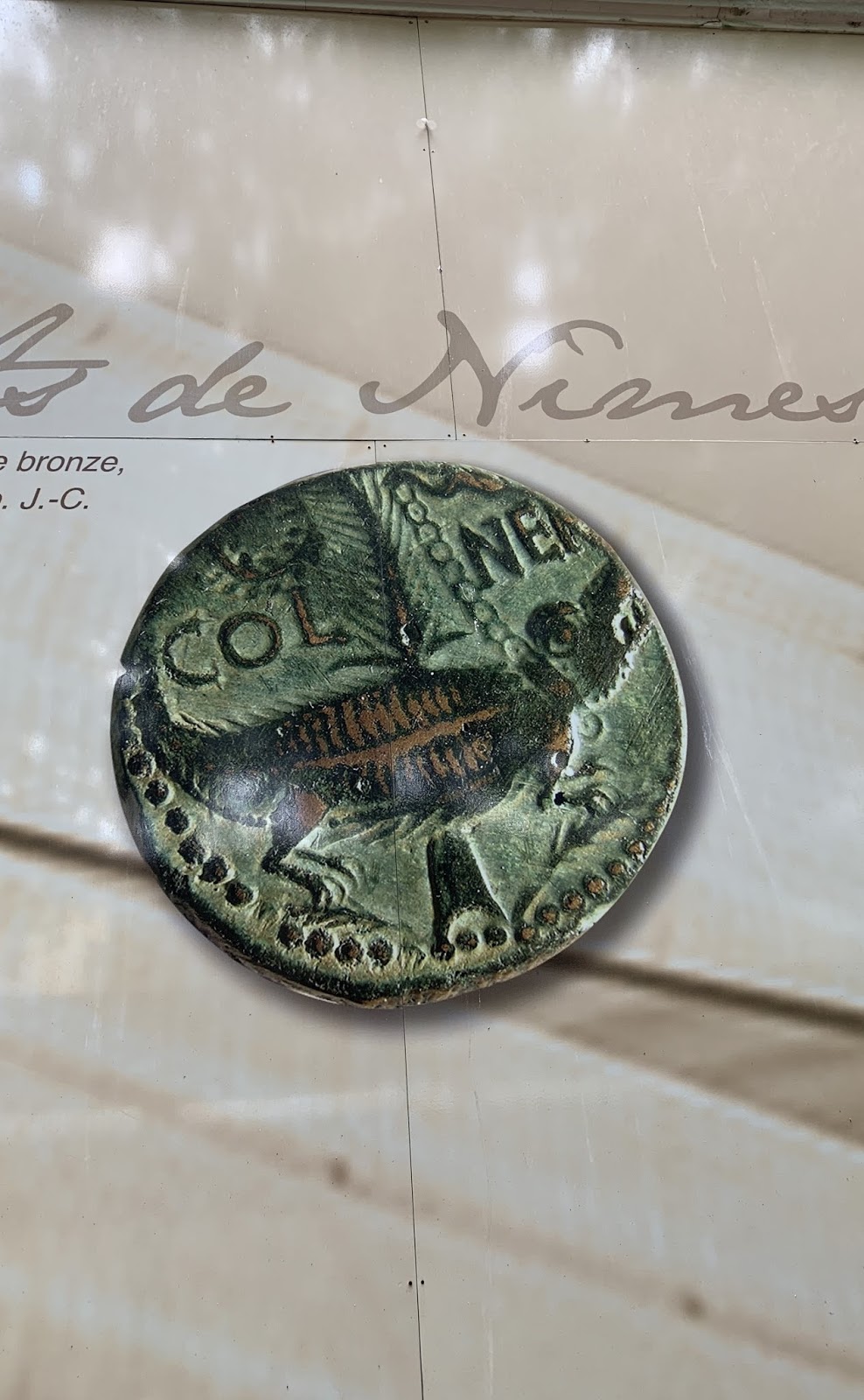
They’re everywhere, on little brass coins in the walkways, embedded in the posts that separate street from walkways, in the signs of restaurants, and there, in the Place du Marche, represented as a full-sized statue in a fountain, the perch of a happy pigeon this hour. The Palm and Crocodile are the symbol of Nimes.


It’s one thing to know this town was once a Roman centre, another to see history in its emblems. In 31 CE, the Roman who subsequently became known as Augustus Caesar defeated our auld buddies Anthony and Cleopatra, and awarded lands in this area of southern Gall to his worthy soldiers. The new coin of this town called Nemausus had the image of the Crocodile chained to the Palm, a symbol of the conquest of Egypt by Rome.


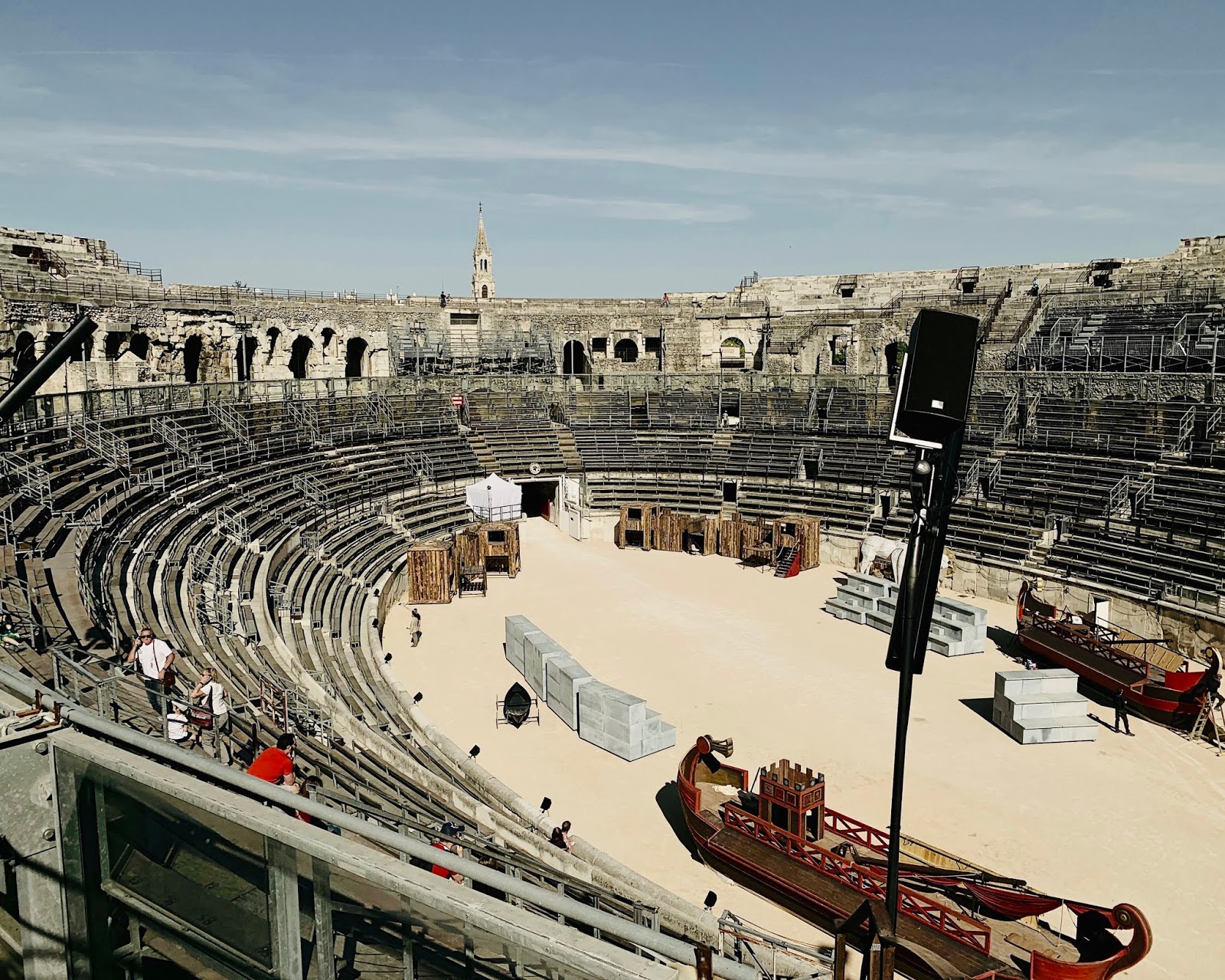
As soon as we had checked into our hotel, we left to visit the arena (built in CE 80), a magnificent amphitheatre just now being set up for the annual Roman Games, an undoubtedly kitschy spectacle of fake galleons and fake gladiators and chariot races and the like. Had we planned better, we might have caught the first night of festivities, but, typical of my planning, we found out too late, and we’re moving on before the games begin. That’s fine, we get to experience Nimes before the crowds arrive, which I’m sure they will.
Arena, built 80 CE

Arena by night


Arena Interior, with props for the Roman Games

Arena interior colonnade

We also visited the Maison Carrière, a remarkably preserved Greco-Roman building that looks like a small version of the Parthenon, and climbed to the top of the Tour Magne once the highest point in the walls of the city. A rather Roman day.

Maison Carrière

Maison Carriere

We ate lunch on the roof of a Modern Art museum overlooking the Maison Carrière. Asparagus soup, a beautiful piece of white fish. Lots of good food, but we were craving salad. Our choice of a restaurant for dinner was based on the selection of salads, and when we squealed in delight when the waiter brought us our huge plates, he must have thought us crazy. Salad and rosé, what could be better!?


Nimes Street


Salad -- with duck & foie gras, because salad without meat is all but inconceivable in France

Monday, November 23, 2015

Berlin – The Berlin Wall Memorial

Day 2
Friday, October 30, 2015.

(Click on photos to enlarge.)

I woke up for the day at 4 a.m., not what I had hoped. The good news, however, is that Europe changes to standard time a week before North America, so we only have to adjust for an eight hour time difference rather than nine. Great.

Got up when I heard stirring in the kitchen, had a pre-Frühstück of yoghurt and muesli. Around 11:00 went for real Frühstück at the Café BilderBuch. John and I had “discovered” this café on our first visit to Berlin in 2010, and we became instant regulars, sitting each morning in the sunny sidewalk, soaking up the street, thinking “I love Europe!” When we visited again, two years later, the BilderBuch was closed for renovations, and we were forced to breakfast elsewhere. There was no loss, really, as there are many great cafés in the neighbourhood serving equally excellent breakfasts. But we were excited to be able to go back to our old haunt this time. Just as I remembered, breakfast was a huge platter of cheese, olives, and fruit, and a basket with four kinds of bread. The tea is a good Assam, and the Kaffee mit Milch is excellent. The prices are higher than I remember from 2010, but there are still great options for 5 or 6 Euros.


John and Ezra and the BilderBuch


The sun never did burn through the fog today. The bright oranges and browns of the leaves made for interesting contrast with grey sky and concrete. Katharina had some errands to run, so Ezra and John and I went off to the Berlin Wall Memorial, a section of the wall that has been preserved as it was before the fall. A small area is closed off completely, viewable only from an observation tower across the street. From there you can see the layers of security behind the concrete wall we’re all familiar with: the signal fencing, the anti-vehicle trench, a patrol road, a watchtower. The most harrowing of the stories are about people who attempted escape across this “death strip.”

Layers of security

There are information kiosks dotting the area now, where a visitor can watch videos and hear first-hand accounts, but after several visits to Berlin, we know the stories. We walked amongst the remnants to absorb the spirit of the place. With the bustle of traffic and the snap of tourist cameras, it’s not all that easy to imagine this place as anything other than a green space, a park, surrounded by thriving commerce, even as the relics loom over us. It feels like long-ago history. That's a good thing.


Sections of preserved wall, with encroaching foliage

Prosperity across the wall

And overlooking all, the Soviet radio tower


* * * * *
One of my quests this visit to Berlin is to seek out knitting stores in the hopes of finding yarn I can’t get at home. One such store is not far from the memorial, so we walked there. KnitKnit was friendly but tiny, and I didn’t find anything unique there, but the walk through the neighbourhood was colourful.


* * * * *
It needs to be mentioned: Berlin streets are full of smokers. Germany has been slow to adopt anti-smoking laws, but at least smoking is banned in restaurants, though not in bars. Smoking is endemic here. This means that to eat on patios is to breathe cigarette smoke, and to walk the streets is to dodge smokers.


* * * * *
We had dinner at the Vietnamese place around the corner, excellent, fresh and healthy. Back home, a glass of wine and a slice of Katharina’s marzipan cake, and we crashed, for another long, restless night.


.