.
July 1, 2015
The little girl next door doesn’t look very happy. When we wish her “Happy Summer!” she shrugs. Then I remember, last September, as school was about to begin, we asked her if she was regretting the end of freedom, and she said, “I like school.” She has more company in that than we might think. School, for the successful, is a pretty good place, loaded with praise from adults and social time with friends. Different story for those who struggle with the rigours of too much sitting still and keeping quiet, with brain-twisting math, and with all those stupid grammar rules.
I have a pass-time that I keep pretty quiet about: I am a gamer. Have been since about 1980, when I mastered Pac Man and Centipede in the arcades – but that’s another story. Anyhow, my current time-suck is SimCity on my iPad. Part of the game is to visit other player’s “cities.” (Not going to explain; it’s irrelevant, and, I'm already sick of it.) Players name their cities. Yesterday, I visited a city called Queen’s land. Just like that, no upper case “l”. I thought, great, but the Queen would never make that error.
Sorry, that’s how teachers think.
Then I thought about the princes, William and Harry, undoubtedly masters now of the, um, Queen’s English, going to school and suffering through the grammar lessons year after year, knowing that they, of all people, would never get away with laziness when it came to language. So many better things to do, like playing polo or shooting fox! But no, they, too would have been required to sit still and keep quiet, and start every sentence with a capital and end it with a period.
For me, the rules have always been a joy. Even as a kid, I remember focussing on the rules, loving the order, the predictability, the logic. I see (correction: have seen) that in plenty of kids: the perfection of their writing says they love it, too. And just recently, after a grammar test (these things are rare in my classroom, which has been more about creative ideas and free writing) in which the kids performed dismally, I hauled out some old-school worksheets, a gazillion of them, for those that needed the practice, pages and pages on capital letters, and pages and pages on commas. What followed was astounding: those kids devoured those worksheets! They worked through page by page, checked in with me after each one, and were visibly delighted as they finally started to get it! One girl in particular, a hard-working, excellent student whose writing was always inexplicably filled with errors, approached me several times for each page on capital letters. As she began to see how it worked, she was so relieved. She’d been aware of her confusion all along, and simply hadn’t known the questions to ask in order to learn how to do it right. She was practically jumping out of her skin, she was so happy to finally understand.
I suppose this says something about how we teach language these days. Or maybe it says something about how the expectations for higher-order thinking has taken precedence over the basics. I don’t know about that. I do know that, if I were to continue teaching, I would do the grammar test at the beginning of the year. I also know that it might not make any difference if I did.
Most kids learn to sit still and keep quiet, at least for short periods of time. Many kids, while sitting still and keeping quiet, actually listen and process what they are hearing. A lot of kids love school, more than folk wisdom would have us believe.
The little girl next door is twelve now, going into Grade 7, my grade. While she adjusts to the summer, hanging out the family laundry over the back yard, cartwheeling on the lawn out front, I think I will be imagining what’s going on in her head. I want to have her over to share the best of what I did with my students (no, not the grammar!) When she goes back to school in September, I will be living that heady time with her, the fresh start to a new year, her final year in elementary school, cozy in the predictability of the rules, the logic and the order.
Showing posts with label Teaching. Show all posts
Showing posts with label Teaching. Show all posts
Wednesday, July 01, 2015


Friday, June 11, 2010
The Beauty of Mathematics
.
Okay, today I’m not thinking about the south of France
lalalalalalalalalalala. . . .
Here it is, the end of the school year. French is done. Social Studies is done. Science, well, I could do more, we’ll see. Language Arts never ends, nor do any of the fine arts.
Curriculum is a constant knocking at the door. “Hey, Human Body!” “Hey, Fractions and Decimals!” “Hey, Five Paragraph Essay!” “Hey, Parts of a Cell!” “Hey, Aspects of Puberty!” “Hey, Elements of Design!” “Hey, Human Rights and Responsibilities!”
Hey, sometimes you just wanna insert earplugs, ya know?
But the year is about done, and the pressure is off, and today I taught the way I would teach every day if there weren’t some 500 learning objectives I had to be sure to cover. It was organic, and it took close to three hours, but I learned a bunch, got excited, and dragged 26 students along with me.
Today, we did math, specifically, the Fibonacci sequence. For those not in the know, it goes like this:
1, 1, 2, 3, 5, 8, 13, 21, 34 . . .
The pattern is to add the last two numbers to get the next. It started in 1202 in Italy
(which appeals to me, being just a few years before the beginning of the Roman Inquisition, in which I’m very interested). Old Fibonacci was charged with the task of figuring out how many rabbits would exist in one year if a single pair were set loose in a field to do the dirty deed, as rabbits are wont to do, apparently.
Here’s what he figured out: Fibonacci Numbers and Nature
. . . along with other good stuff.
So, when we got through rabbits, we got into the very elementary genetics of the problems of brothers and sisters mating (the thought of which was too shocking for even pubescent boys to respond!), and managed, somehow, to get into the theoretical probability of two brown-eyed parents producing a blue-eyed child. (“Can we take a survey?” they asked, and this teacher rejoiced!) Our class was way outside the expected norm, with a whole lot of blue-eyed children of brown-eyed parents – so that’s the next exploration, I guess.
Back to Fibonacci. We drew out a series of squares based on the Fibonacci series. Kids were hooked. Then we drew a spiral line within the Fibonacci squares. Kids were blown away. There was K., my perpetual I-can’t-do-it kid, staring at his own work in amazement. “Can you believe you did that?” I asked.
“No.” That is what he said.
So, here it is. I think I’ve been doing it backwards, and I’m not alone. Somewhere around Grade 3, we start getting kids to learn the multiplication table. At Grade 5 and 6, which I teach, we expect them to know it, automatically. Most of them don’t, of course, and so every operation they have to do hurts, in a visceral way. I know, because that was my own experience as a kid.
We never tell them why they should want to do this. It’s like providing a map without saying anything about the treasure; there is no “x marks the spot”. Why would anyone care to follow?
In a strange coincidence, my principal sent a link today to a slide show called, “Beauty of Mathematics”. I showed it to my class, and they were so excited. They just hadn’t thought of math this way, and, to be honest, neither had I.
The end part, the didactic preachy part about reaching 100 per cent is nonsense, of course.*
I am working on trying to find a link or an attachment that I can post here. Meanwhile, you may have to do your own search for "Beauty of Mathematics" and put up with the God stuff that was NOT a part of the slideshow I showed my students, though the non-God stuff is the same.
One nice thing about teaching is that you get to try again next year. I hope I will have the courage, next year, to start with the turn-on, the treasure – Fibonacci, nature, and the amazing things numbers do – and then get to the steps you need to take to get to the treasure. I bet I’ll be able to entice a few kids who would otherwise would stay behind.
*On a completely different tack: when I googled this slide show so that I could post it on facebook, what I found was somehow attached to “the Love of God”, which gets you to 101%. The slide show was the same, but included God as part of the “equation”. Nauseating. Best I can do is post this blog and link it through facebook. God might try, but it can’t win.
.
Okay, today I’m not thinking about the south of France
lalalalalalalalalalala. . . .
Here it is, the end of the school year. French is done. Social Studies is done. Science, well, I could do more, we’ll see. Language Arts never ends, nor do any of the fine arts.
Curriculum is a constant knocking at the door. “Hey, Human Body!” “Hey, Fractions and Decimals!” “Hey, Five Paragraph Essay!” “Hey, Parts of a Cell!” “Hey, Aspects of Puberty!” “Hey, Elements of Design!” “Hey, Human Rights and Responsibilities!”
Hey, sometimes you just wanna insert earplugs, ya know?
But the year is about done, and the pressure is off, and today I taught the way I would teach every day if there weren’t some 500 learning objectives I had to be sure to cover. It was organic, and it took close to three hours, but I learned a bunch, got excited, and dragged 26 students along with me.
Today, we did math, specifically, the Fibonacci sequence. For those not in the know, it goes like this:
1, 1, 2, 3, 5, 8, 13, 21, 34 . . .
The pattern is to add the last two numbers to get the next. It started in 1202 in Italy
(which appeals to me, being just a few years before the beginning of the Roman Inquisition, in which I’m very interested). Old Fibonacci was charged with the task of figuring out how many rabbits would exist in one year if a single pair were set loose in a field to do the dirty deed, as rabbits are wont to do, apparently.
Here’s what he figured out: Fibonacci Numbers and Nature
. . . along with other good stuff.
So, when we got through rabbits, we got into the very elementary genetics of the problems of brothers and sisters mating (the thought of which was too shocking for even pubescent boys to respond!), and managed, somehow, to get into the theoretical probability of two brown-eyed parents producing a blue-eyed child. (“Can we take a survey?” they asked, and this teacher rejoiced!) Our class was way outside the expected norm, with a whole lot of blue-eyed children of brown-eyed parents – so that’s the next exploration, I guess.
Back to Fibonacci. We drew out a series of squares based on the Fibonacci series. Kids were hooked. Then we drew a spiral line within the Fibonacci squares. Kids were blown away. There was K., my perpetual I-can’t-do-it kid, staring at his own work in amazement. “Can you believe you did that?” I asked.
“No.” That is what he said.
So, here it is. I think I’ve been doing it backwards, and I’m not alone. Somewhere around Grade 3, we start getting kids to learn the multiplication table. At Grade 5 and 6, which I teach, we expect them to know it, automatically. Most of them don’t, of course, and so every operation they have to do hurts, in a visceral way. I know, because that was my own experience as a kid.
We never tell them why they should want to do this. It’s like providing a map without saying anything about the treasure; there is no “x marks the spot”. Why would anyone care to follow?
In a strange coincidence, my principal sent a link today to a slide show called, “Beauty of Mathematics”. I showed it to my class, and they were so excited. They just hadn’t thought of math this way, and, to be honest, neither had I.
The end part, the didactic preachy part about reaching 100 per cent is nonsense, of course.*
I am working on trying to find a link or an attachment that I can post here. Meanwhile, you may have to do your own search for "Beauty of Mathematics" and put up with the God stuff that was NOT a part of the slideshow I showed my students, though the non-God stuff is the same.
One nice thing about teaching is that you get to try again next year. I hope I will have the courage, next year, to start with the turn-on, the treasure – Fibonacci, nature, and the amazing things numbers do – and then get to the steps you need to take to get to the treasure. I bet I’ll be able to entice a few kids who would otherwise would stay behind.
*On a completely different tack: when I googled this slide show so that I could post it on facebook, what I found was somehow attached to “the Love of God”, which gets you to 101%. The slide show was the same, but included God as part of the “equation”. Nauseating. Best I can do is post this blog and link it through facebook. God might try, but it can’t win.
.
Monday, January 04, 2010
Epiphany
.
I don’t know what has happened to me, regarding writing. I suppose there is a fine balance between work and reward, and, of late, to write has been more work than reward.
But I have a small story to share.
A boy in my class (I’ll call him Aaron) lost his dad a few weeks ago, suddenly. I don’t know if there can be a worse time for a boy to lose his dad—the kid’s 11—not that there’s any good time, but I grieve for this kid, and I am at a loss as to what to do for him. My gut feeling is that it might help him to concentrate on school work, to put his grief out of mind momentarily. So I’m pressing him, gently.
Just before the winter break, we were wrapping up a months-long study of Rodman Philbrick’s wonderful novel, Freak the Mighty. We were all in love with the book and it’s rough-cut protagonist, Max. As a final assignment, I asked students to imagine that the book was being remade into a feature film, and that they were under consideration to play one of the two main characters. I asked them to explain which character they would play best, and why—how did they see themselves as similar to that character, and how could they relate to the experience of being Max or Kevin.
Aaron was struggling, knowing which character was closest to him, but not having a clue what to say about that. I asked him if he could see any similarities between Max’s experience with his dad and Aaron’s own. (Big risk, I know, but I want Aaron to know it’s okay to talk about his dad’s death, that it doesn’t have to be private or hidden.) Aaron saw the connection and started to write about it.
Meanwhile, another boy in the class had discovered a flip-chart I have, aimed at students, filled with tips for improving writing; he had found the page that gives alternative words for dull, overused ones. You know—you remember those teachers saying, “Don’t say ‘said’, don’t say ‘went!’” —same old thing. This boy made lots of noise about his discovery, excited to look for interesting language, making sure everyone else heard about it too. (Sometimes these “disruptions” are the best thing that can happen to a classroom!)
Aaron picked up on it. He came up to me, wanting to find a better word for “sad”. There was nothing in the flip chart. I showed him how to use a thesaurus. We found “sad,” with a long list of wonderful substitutes: devastated, wretched, miserable. I left it with Aaron to make his choice.
Some time later Aaron came up to me again, his face bright with excitement. “I found the right word!” he said. I was thrilled.
“What’s the word?” I asked him.
He burst out, “Unhappy!”
“Wow, great,” was all I could say, “Good for you!”
And eventually, there was Aaron’s paper, a short paragraph with that one special word. “I’ll never see my dad again, and that’s very unhappy for me.”
Who knows what’s in the hearts, or the heads, of children? Who knows how a boy grieves for his father? Who are we to say they need flamboyant expression for their feelings?
For Aaron, “unhappy” was an epiphany. Now he has more than one word to describe how he’s feeling.
.
I don’t know what has happened to me, regarding writing. I suppose there is a fine balance between work and reward, and, of late, to write has been more work than reward.
But I have a small story to share.
A boy in my class (I’ll call him Aaron) lost his dad a few weeks ago, suddenly. I don’t know if there can be a worse time for a boy to lose his dad—the kid’s 11—not that there’s any good time, but I grieve for this kid, and I am at a loss as to what to do for him. My gut feeling is that it might help him to concentrate on school work, to put his grief out of mind momentarily. So I’m pressing him, gently.
Just before the winter break, we were wrapping up a months-long study of Rodman Philbrick’s wonderful novel, Freak the Mighty. We were all in love with the book and it’s rough-cut protagonist, Max. As a final assignment, I asked students to imagine that the book was being remade into a feature film, and that they were under consideration to play one of the two main characters. I asked them to explain which character they would play best, and why—how did they see themselves as similar to that character, and how could they relate to the experience of being Max or Kevin.
Aaron was struggling, knowing which character was closest to him, but not having a clue what to say about that. I asked him if he could see any similarities between Max’s experience with his dad and Aaron’s own. (Big risk, I know, but I want Aaron to know it’s okay to talk about his dad’s death, that it doesn’t have to be private or hidden.) Aaron saw the connection and started to write about it.
Meanwhile, another boy in the class had discovered a flip-chart I have, aimed at students, filled with tips for improving writing; he had found the page that gives alternative words for dull, overused ones. You know—you remember those teachers saying, “Don’t say ‘said’, don’t say ‘went!’” —same old thing. This boy made lots of noise about his discovery, excited to look for interesting language, making sure everyone else heard about it too. (Sometimes these “disruptions” are the best thing that can happen to a classroom!)
Aaron picked up on it. He came up to me, wanting to find a better word for “sad”. There was nothing in the flip chart. I showed him how to use a thesaurus. We found “sad,” with a long list of wonderful substitutes: devastated, wretched, miserable. I left it with Aaron to make his choice.
Some time later Aaron came up to me again, his face bright with excitement. “I found the right word!” he said. I was thrilled.
“What’s the word?” I asked him.
He burst out, “Unhappy!”
“Wow, great,” was all I could say, “Good for you!”
And eventually, there was Aaron’s paper, a short paragraph with that one special word. “I’ll never see my dad again, and that’s very unhappy for me.”
Who knows what’s in the hearts, or the heads, of children? Who knows how a boy grieves for his father? Who are we to say they need flamboyant expression for their feelings?
For Aaron, “unhappy” was an epiphany. Now he has more than one word to describe how he’s feeling.
.
Tuesday, March 17, 2009
Outdoor School
.
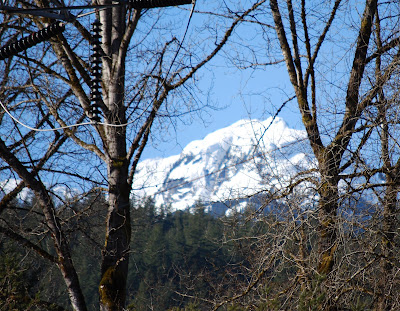
Once again, I took my Grade 6 class to the North Vancouver Outdoor School. We had about 80 kids there, with four teachers, from two schools. The idea is that each teacher develops and delivers a field study in some way related to the outdoor environment. Resident Outdoor School teachers also deliver field studies, so that there are six in all, and the kids rotate through all of them. That means teaching twelve to fifteen kids at a time in two-hour sessions, repeating the study six times. High-school aged counselors accompany us, assisting and eventually taking over the study.
The Outdoor School is a wonderful facility situated in Paradise Valley, beside the Cheakamus River. There are salmon spawning streams running through the property, a salmon hatchery, original cedar stands, and a small farm. Studies are usually related to natural history, and can include Birds of Prey, Salmon Studies, Farm Study, a guided Boardwalk explaining the natural history of the area. I always choose Poetry as my study; I consider it a different way to connect to the outdoors - to be quiet and aware out there, to observe closely, to describe the sensory experiences of being in such a place.
Oh, I get attitude. I get faces, usually from a boy or two. I get mumblings of “I hate poetry.” I ignore all that. I start by drawing the analogy between poetic (or artistic) observation and scientific observation, how everything we know about our world comes from observing it closely. I talk about the senses, and about not making sense. I tell the kids they never have to show their work to anyone, if they don’t want to. (Last year, this brought out the query, from a predictable source: “Can we use the f word?” I said, sure, if you need to.) The liberty of writing for only themselves seems to settle the dissidents.
I hand out clipboards and pencils and a little chapbook for each poet, and we walk. I take them on the Moss Trail, which leads through some wonderful Douglas Fir stands with plenty of open ground for sitting, to a rehabilitated creek beside some boulder-formed caves. We make several stops along the way for writing.

I introduce each poem for writing, one at a time, then send the kids to find a spot to sit (on a sitting pad). The counselor and I stand silently while they write.
I love those moments, kids crouched beneath trees hanging with old man’s beard - moss brilliant in the sun - kids bent in concentration, the glances up as they gather ideas like the Original People gathering roots. I love how everything becomes amplified in those moments: the roosters from the far-off farm, a chickadee’s mating call, a small plane overhead, the wavering patches of sunlight on the litter of the forest floor.

I guide the kids through six poems. The first asks where a poem might hide, if the poem were a creature; look around at all the places some small critter might hide. The second holds a dialogue with some other-than-human living thing, a tree, a bear, a centipede. The third is a shopping list that some wild animal might write. For the fourth, we blindfold the kids, and they sit and let the senses other than sight take over. The fifth - we are beside the creek by this time - is a 360° poem, in which the poet stands in one place and describes scene after scene as she turns around in a full circle. The last poem, the finale, is a stick poem, a short message written on a small stick, sent downstream for some future hiker to find.

I invite students to read their poems if they want to. Some of the poems show surprising insight and sensitivity. Many of them venture into metaphor and “big ideas”. I have no idea how conscious the writers are of what they’ve done, but I’m not concerned with that. My purpose is to open up these kids’ minds to some possibilities they may not have thought of before. Other than the poems kids choose to read, my indication that I’ve been successful is the quiet that blankets the group once we’ve started, the acceptance of the tasks, and the change in attitude apparent as we wrap up.
Does any of it matter to the kids? Who knows? For me, the study is a gift of two hours of quiet introspection, in a magnificent outdoors. I love it, and if one or two of them love it too, that’s a bonus.
.

Once again, I took my Grade 6 class to the North Vancouver Outdoor School. We had about 80 kids there, with four teachers, from two schools. The idea is that each teacher develops and delivers a field study in some way related to the outdoor environment. Resident Outdoor School teachers also deliver field studies, so that there are six in all, and the kids rotate through all of them. That means teaching twelve to fifteen kids at a time in two-hour sessions, repeating the study six times. High-school aged counselors accompany us, assisting and eventually taking over the study.
The Outdoor School is a wonderful facility situated in Paradise Valley, beside the Cheakamus River. There are salmon spawning streams running through the property, a salmon hatchery, original cedar stands, and a small farm. Studies are usually related to natural history, and can include Birds of Prey, Salmon Studies, Farm Study, a guided Boardwalk explaining the natural history of the area. I always choose Poetry as my study; I consider it a different way to connect to the outdoors - to be quiet and aware out there, to observe closely, to describe the sensory experiences of being in such a place.
Oh, I get attitude. I get faces, usually from a boy or two. I get mumblings of “I hate poetry.” I ignore all that. I start by drawing the analogy between poetic (or artistic) observation and scientific observation, how everything we know about our world comes from observing it closely. I talk about the senses, and about not making sense. I tell the kids they never have to show their work to anyone, if they don’t want to. (Last year, this brought out the query, from a predictable source: “Can we use the f word?” I said, sure, if you need to.) The liberty of writing for only themselves seems to settle the dissidents.
I hand out clipboards and pencils and a little chapbook for each poet, and we walk. I take them on the Moss Trail, which leads through some wonderful Douglas Fir stands with plenty of open ground for sitting, to a rehabilitated creek beside some boulder-formed caves. We make several stops along the way for writing.

I introduce each poem for writing, one at a time, then send the kids to find a spot to sit (on a sitting pad). The counselor and I stand silently while they write.
I love those moments, kids crouched beneath trees hanging with old man’s beard - moss brilliant in the sun - kids bent in concentration, the glances up as they gather ideas like the Original People gathering roots. I love how everything becomes amplified in those moments: the roosters from the far-off farm, a chickadee’s mating call, a small plane overhead, the wavering patches of sunlight on the litter of the forest floor.

I guide the kids through six poems. The first asks where a poem might hide, if the poem were a creature; look around at all the places some small critter might hide. The second holds a dialogue with some other-than-human living thing, a tree, a bear, a centipede. The third is a shopping list that some wild animal might write. For the fourth, we blindfold the kids, and they sit and let the senses other than sight take over. The fifth - we are beside the creek by this time - is a 360° poem, in which the poet stands in one place and describes scene after scene as she turns around in a full circle. The last poem, the finale, is a stick poem, a short message written on a small stick, sent downstream for some future hiker to find.

I invite students to read their poems if they want to. Some of the poems show surprising insight and sensitivity. Many of them venture into metaphor and “big ideas”. I have no idea how conscious the writers are of what they’ve done, but I’m not concerned with that. My purpose is to open up these kids’ minds to some possibilities they may not have thought of before. Other than the poems kids choose to read, my indication that I’ve been successful is the quiet that blankets the group once we’ve started, the acceptance of the tasks, and the change in attitude apparent as we wrap up.
Does any of it matter to the kids? Who knows? For me, the study is a gift of two hours of quiet introspection, in a magnificent outdoors. I love it, and if one or two of them love it too, that’s a bonus.
.
Saturday, September 27, 2008
To Save a Child
.
Vancouver’s North Shore has recently seen the influx of numerous Korean immigrants, and classrooms have become generously sprinkled with children who arrive speaking little or no English. We have Jin Joo, Dong Gwan, Jin Shiu, Hae Reen, and many more. It seems to be convention for these kids to take “Canadian” names shortly after their arrival, likely in response to the constant mispronunciation of their names by teachers and classmates - they become Jane, Mike, Annie, Elly.
Dong Baum (pronounced Bum) Shin went by his Korean name longer than most, and, surprisingly, his playmates didn’t appear to notice that it sounded like an unfortunate conglomeration of body parts. Eventually, however, he decided to take a Canadian name, and wanted to be called Harry, after the famous Harry Potter.
It happens that original names in the school registers are often typed up in parentheses after the new, assumed name, and so Dong Baum, as Harry, would become Harry Dong Bum Shin. This might escape the notice of his Grade 4 classmates this year, but what would happen in, say, Grade 6, or worse, high school, the name iterated by eight consecutive teachers trying to keep straight faces.
Poor Dong Baum didn’t know that Harry was a homophone with “hairy,” and he certainly didn’t know about “dong.” The teacher was in the awkward position of having to explain. How to advise a child about to invite slaughter by even the kindest of his classmates, and laughter from every would-be employer reading his C.V.? How to convey the Canadian meaning of “dong”?
His last name, as it turns out, was not so unfortunate after all. Dong Baum’s teacher was able to convince him that he would not want to be called “Hairy Shin” for the rest of his life, and he decided, instead, to become “Danny.”
And so Danny (Dong Baum) Shin - a sweet, quiet boy - is safe for now.
.
Vancouver’s North Shore has recently seen the influx of numerous Korean immigrants, and classrooms have become generously sprinkled with children who arrive speaking little or no English. We have Jin Joo, Dong Gwan, Jin Shiu, Hae Reen, and many more. It seems to be convention for these kids to take “Canadian” names shortly after their arrival, likely in response to the constant mispronunciation of their names by teachers and classmates - they become Jane, Mike, Annie, Elly.
Dong Baum (pronounced Bum) Shin went by his Korean name longer than most, and, surprisingly, his playmates didn’t appear to notice that it sounded like an unfortunate conglomeration of body parts. Eventually, however, he decided to take a Canadian name, and wanted to be called Harry, after the famous Harry Potter.
It happens that original names in the school registers are often typed up in parentheses after the new, assumed name, and so Dong Baum, as Harry, would become Harry Dong Bum Shin. This might escape the notice of his Grade 4 classmates this year, but what would happen in, say, Grade 6, or worse, high school, the name iterated by eight consecutive teachers trying to keep straight faces.
Poor Dong Baum didn’t know that Harry was a homophone with “hairy,” and he certainly didn’t know about “dong.” The teacher was in the awkward position of having to explain. How to advise a child about to invite slaughter by even the kindest of his classmates, and laughter from every would-be employer reading his C.V.? How to convey the Canadian meaning of “dong”?
His last name, as it turns out, was not so unfortunate after all. Dong Baum’s teacher was able to convince him that he would not want to be called “Hairy Shin” for the rest of his life, and he decided, instead, to become “Danny.”
And so Danny (Dong Baum) Shin - a sweet, quiet boy - is safe for now.
.
Wednesday, May 21, 2008
Idols
.
My almost-twelve-year-old students will be grieving tonight; their Idol did not win. Yeah, I mean American Idol, and though I can think of many reasons I shouldn't watch that show, or at least shouldn't admit to watching it, I'm as hooked as any tweeny girl. John and I watch together and offer up our criticisms, second-guessing the judges, actively agreeing with Simon Cowell usually but not always.
Sadie's gonna marry David Archuleta. She's got it all figured out: when she'll be twenty, he'll be twenty-six, and that sounds okay, he's really not too old for her. Norah won't claim him for a future husband, but her smile is more brilliant than ever when his name comes up. (But she could be an Idol one day herself, such a singer she is.) I found a poem on the classroom floor today, on a scrap of paper, describing his "sparkling eyes." Twelve-year-olds haven't been around long enough to know how tired that sounds. Twelve-year-olds know love as much as anyone, though.
I want to tell them how I loved Fang. I mentioned that to John, not thinking, really. He said, "Fang??" Oops. "FANG!?? Who the hell's Fang? You loved someone called Fang?? My best friend's dog was called Fang!"
Yeah, well, oops. Maybe some secrets are best kept.
But I want to tell them how, in the summer of twelve, Anne and I sat up in the cherry tree talking about Fang and Mark, how I'd have one and she'd have the other. (Oh, yeah, they were from Paul Revere and the Raiders, a pop-rock band who wore pastel American Revolutionary period dress.) I want to tell them about the poster I had on my closet door, and the ink that wore away from so many goodnight kisses. They'd shriek, they'd cry with laughter. And they'd know that I knew how they loved.
There was a flurry of "family life" questions today. I keep a box of little slips of paper and an envelope at the side of the room, expressly for the purpose. The envelope sits empty most of the time, but then something flutters in the room, a kid grabs a slip of paper and pretends to be subtle about putting it in the envelope. Everyone suddenly remembers the questions that have been burning in their brains since the last session.
"Why would a woman put her mouth on a man's penis?" I say that maybe it's because the man would like it, and hope that they get the message that it's about giving, not taking. I tell them adults can do anything together that they both want as a part of loving and communicating, and that THEY, the twelve-year-olds never have to do any of it if they don't want to. (Thanks to Meg Hickling for that, wonderful sex educator.)
"What happens if a man bangs a woman too hard?" How do you answer a question like that? I say, again, that sex is an act of love and communication, that as such, there is no "too hard." I say rape would be too hard, and would do the woman harm, but, again, rape has nothing to do with sex, no matter what it looks like.
"What's an orgasm, and how do girls have one?"
So many questions come up again and again, as if they want to be sure they heard me right the first time, or to see if the answer remains the same, or maybe they didn't understand the first time and now they hope they might. Or maybe they're just setting me up. Doesn't matter. I told them at the start there wasn't a question they could ask that would embarrass me. I think they've tried, despite that. Could be that they're mortified as I read the questions aloud and proceed with graphic answers.
Talking about Fang would probably embarrass me, though.
I thought tonight would be the coronation of David Archuleta; that seemed to be the prevailing opinion. Of the two finalists, his voice is the purest, one of those voices that sends shivers down your spine; at seventeen, he seems something of a miracle, such is his musicality. I shouted when David Cook was announced the winner; he was my man. I am not a fan of "pop" music. No matter how good the voice, I would not buy the record. David Cook, however, seems to be a real musician, competent on his guitar, arranging tunes in unique and tasty ways. I'll be interested in his album, when it's made.
Archuleta, meanwhile, has inspired probably tens of millions of tweeny girl fantasies, and at least a dozen questions in a classroom in North Vancouver.
(Students' names have been changed.)
.
My almost-twelve-year-old students will be grieving tonight; their Idol did not win. Yeah, I mean American Idol, and though I can think of many reasons I shouldn't watch that show, or at least shouldn't admit to watching it, I'm as hooked as any tweeny girl. John and I watch together and offer up our criticisms, second-guessing the judges, actively agreeing with Simon Cowell usually but not always.
Sadie's gonna marry David Archuleta. She's got it all figured out: when she'll be twenty, he'll be twenty-six, and that sounds okay, he's really not too old for her. Norah won't claim him for a future husband, but her smile is more brilliant than ever when his name comes up. (But she could be an Idol one day herself, such a singer she is.) I found a poem on the classroom floor today, on a scrap of paper, describing his "sparkling eyes." Twelve-year-olds haven't been around long enough to know how tired that sounds. Twelve-year-olds know love as much as anyone, though.
I want to tell them how I loved Fang. I mentioned that to John, not thinking, really. He said, "Fang??" Oops. "FANG!?? Who the hell's Fang? You loved someone called Fang?? My best friend's dog was called Fang!"
Yeah, well, oops. Maybe some secrets are best kept.
But I want to tell them how, in the summer of twelve, Anne and I sat up in the cherry tree talking about Fang and Mark, how I'd have one and she'd have the other. (Oh, yeah, they were from Paul Revere and the Raiders, a pop-rock band who wore pastel American Revolutionary period dress.) I want to tell them about the poster I had on my closet door, and the ink that wore away from so many goodnight kisses. They'd shriek, they'd cry with laughter. And they'd know that I knew how they loved.
There was a flurry of "family life" questions today. I keep a box of little slips of paper and an envelope at the side of the room, expressly for the purpose. The envelope sits empty most of the time, but then something flutters in the room, a kid grabs a slip of paper and pretends to be subtle about putting it in the envelope. Everyone suddenly remembers the questions that have been burning in their brains since the last session.
"Why would a woman put her mouth on a man's penis?" I say that maybe it's because the man would like it, and hope that they get the message that it's about giving, not taking. I tell them adults can do anything together that they both want as a part of loving and communicating, and that THEY, the twelve-year-olds never have to do any of it if they don't want to. (Thanks to Meg Hickling for that, wonderful sex educator.)
"What happens if a man bangs a woman too hard?" How do you answer a question like that? I say, again, that sex is an act of love and communication, that as such, there is no "too hard." I say rape would be too hard, and would do the woman harm, but, again, rape has nothing to do with sex, no matter what it looks like.
"What's an orgasm, and how do girls have one?"
So many questions come up again and again, as if they want to be sure they heard me right the first time, or to see if the answer remains the same, or maybe they didn't understand the first time and now they hope they might. Or maybe they're just setting me up. Doesn't matter. I told them at the start there wasn't a question they could ask that would embarrass me. I think they've tried, despite that. Could be that they're mortified as I read the questions aloud and proceed with graphic answers.
Talking about Fang would probably embarrass me, though.
I thought tonight would be the coronation of David Archuleta; that seemed to be the prevailing opinion. Of the two finalists, his voice is the purest, one of those voices that sends shivers down your spine; at seventeen, he seems something of a miracle, such is his musicality. I shouted when David Cook was announced the winner; he was my man. I am not a fan of "pop" music. No matter how good the voice, I would not buy the record. David Cook, however, seems to be a real musician, competent on his guitar, arranging tunes in unique and tasty ways. I'll be interested in his album, when it's made.
Archuleta, meanwhile, has inspired probably tens of millions of tweeny girl fantasies, and at least a dozen questions in a classroom in North Vancouver.
(Students' names have been changed.)
.
Subscribe to:
Posts (Atom)